You can build community where you live by starting with one small, repeatable gathering — a monthly block coffee, a quarterly skill swap, or a shared tool list — and letting it grow through neighbors rather than through a big one-time event. The method matters more than the scale: groups that meet on a predictable rhythm survive, while one-off parties rarely turn into anything.
This guide walks through three formats that work in most neighborhoods: block gatherings, skill swaps, and ongoing neighborhood groups. It covers how to choose one, how to run the first meeting, and how to keep it going after the novelty wears off. The advice is general and durable; it is information, not a promise of any particular result.
Community is a skill like any other, and it overlaps with the networks women already build at work and in community coverage here — the difference is that a neighborhood group runs on proximity, not shared employers or industries. That proximity is the asset. It also means the group lives or dies on the few people who show up consistently.
Which format should you start with?
Start with the format that matches the smallest thing your neighbors would already say yes to. A block gathering asks the least: people bring themselves and maybe a chair. A skill swap asks a little more: each person offers one thing they can teach or lend. A standing neighborhood group asks the most, because it needs a purpose that lasts beyond the first meeting.
A useful test is to ask what people in your area already do informally. If neighbors already chat over kids' bikes and lawnmowers, a block gathering formalizes something that exists. If people mostly stay inside, a skill swap gives them a concrete reason to meet — everyone gets something out of it, which lowers the social risk of showing up.
Choose one format and commit to it for at least three cycles. Running three formats badly is the most common way neighborhood efforts stall. One format done predictably builds the trust that makes the next one easy.
How do you run a first block gathering?
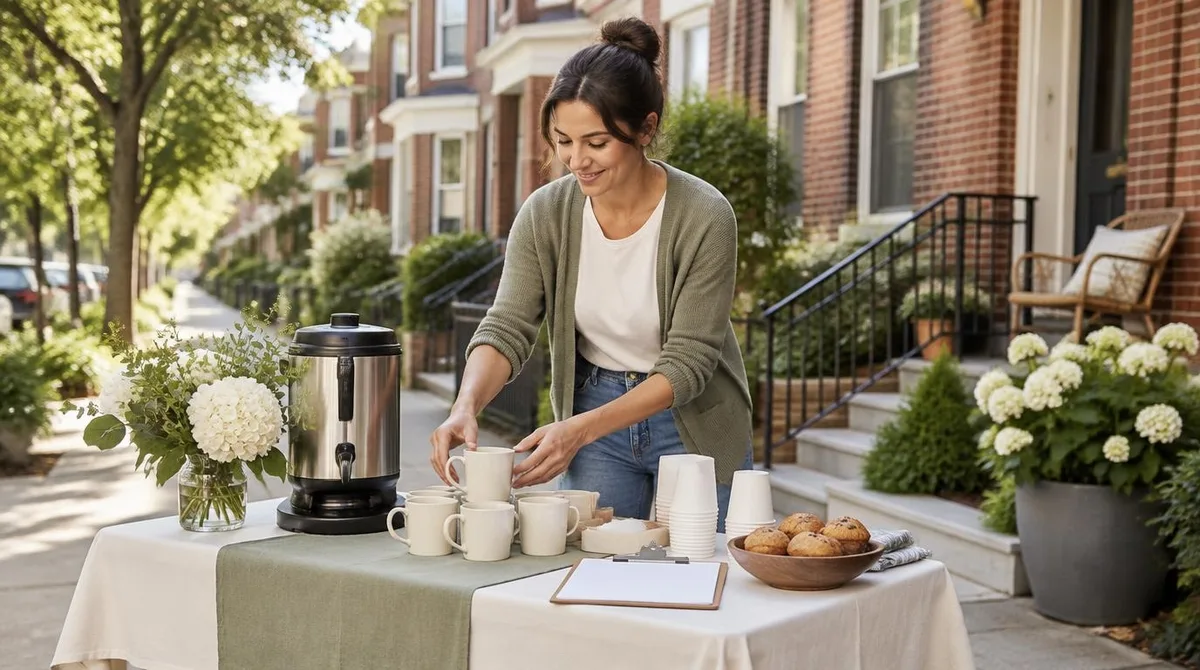
Run the first one as small as possible. Pick a date six to eight weeks out, choose a low-effort venue — a driveway, a shared courtyard, a corner of a park — and invite the houses you can reach on foot. Paper flyers on doors still outperform most digital invitations for a first event, because they reach people who never joined the neighborhood app.
- Pick a simple, fixed time, such as a Saturday morning or a weekday early evening, and plan to repeat it monthly.
- Make it bring-nothing or bring-anything. Requiring specific contributions raises the barrier for people who are unsure about coming.
- Keep a visible, simple sign-in sheet or a shared contact list. The list, not the event, is what you are really building.
- End on time. A gathering that runs long feels like a chore; one that ends cleanly is easy to attend again.
- Before people leave, name the next date out loud. An announced next date converts far more attendees than a "see you around."
Expect a small turnout at the first event. Five people who talk for an hour is a working community seed. The number that matters is how many of those five come back the second time, so put your energy into the follow-up, not the guest count.
What makes a skill swap work?
A skill swap works when every offer is small, specific, and low-stakes. The format is simple: each participant writes down one thing they can teach or help with — sewing a button, reading a contract, fixing a bike chain, setting up a phone — and one thing they want help with. People match themselves and arrange their own follow-up.
Keep the first swap to an hour. Give everyone thirty seconds to state what they offer and what they need, then let the room sort itself out. Structured intros prevent the dynamic where confident talkers dominate and quieter neighbors leave without a match.
Set expectations clearly: a swap is a favor exchange between neighbors, not a business arrangement. If someone wants to charge for their skill, that is a different event with different rules, and mixing the two in one room makes people wary. A simple written norm at the start — favors are free, skills stay amateur, follow-up is between the two people — prevents most friction.
Repeat the swap two or three times a year. Between swaps, a shared document listing who offers what keeps the exchange alive without anyone organizing anything.
How do you turn a one-off event into a lasting group?
Turn a one-off event into a group by giving it three things: a fixed rhythm, a shared record, and more than one organizer. A group that exists only in one person's head ends when that person moves or burns out. A group with a monthly date, a simple contact list, and two or three co-organizers survives all three.
Decide early what the group is for, in one sentence. "We help neighbors on our block share tools, skills, and emergency contacts" is a charter. A group with no stated purpose drifts into whatever the loudest member wants, which is how neighborhood groups acquire reputations that keep newcomers away.
Write down the norms neighbors actually need: how decisions get made, what the group will and will not get involved in, and how someone joins. Keep it to a paragraph. Groups that try to govern everything end up governing nothing well.
Hand off roles on a schedule. If you have run the sign-in sheet for six months, teach it to someone else and take a different job. Rotation is not just burnout prevention — it signals that the group belongs to the block, not to its founder.
What this means for your wider network
A neighborhood group will not replace professional networks, but it changes what those networks are anchored to. Local trust is the kind that shows up in a crisis — a hospital stay, a job loss, a move — in ways that a professional contact list does not. Many women find that the same organizing habits transfer: running a block gathering uses the muscles that running a workplace coalition or a volunteer program uses. We covered a connected angle in Local chambers of commerce and what they do for women owners.
If your goal is partly career-shaped, pair the neighborhood work with structures built for it. A local chamber of commerce connects you to business owners nearby, and volunteering that builds career skills can put you on a team with a real role. For groups with a more formal purpose, the mechanics of starting a peer accountability group apply almost word for word to a neighborhood version. For related coverage, see Starting a peer accountability group at work or beyond it.
Even digital communities offer a lesson worth borrowing here. Roblox's own documentation for its Build tool describes how a shared creative project works: you describe what you want, playtest it with a small group of up to ten friends before opening it wider, and keep refining after launch (Roblox Creator Hub, Build documentation). The sequence — small private test, then broader release, then ongoing iteration — is exactly how a durable neighborhood group forms. Launch to ten people, adjust, then widen.
Where do neighborhood groups go from here?
Neighborhood groups tend to grow in one of two directions: they stay small and hyperlocal, or they federate with similar groups nearby to share tools, costs, and notices. Neither is better. The failure mode is not choosing — a group that tries to be both a block coffee and a civic organization serves neither purpose.
The evidence for what makes local community work is mostly practical, not statistical: predictable rhythm, low barriers to entry, shared record-keeping, and distributed leadership. What remains unknown is which format fits a given street, and the only reliable way to find out is to run one cycle and observe who returns. Start smaller than feels ambitious, name the next date before anyone leaves, and let the group tell you what it wants to become.