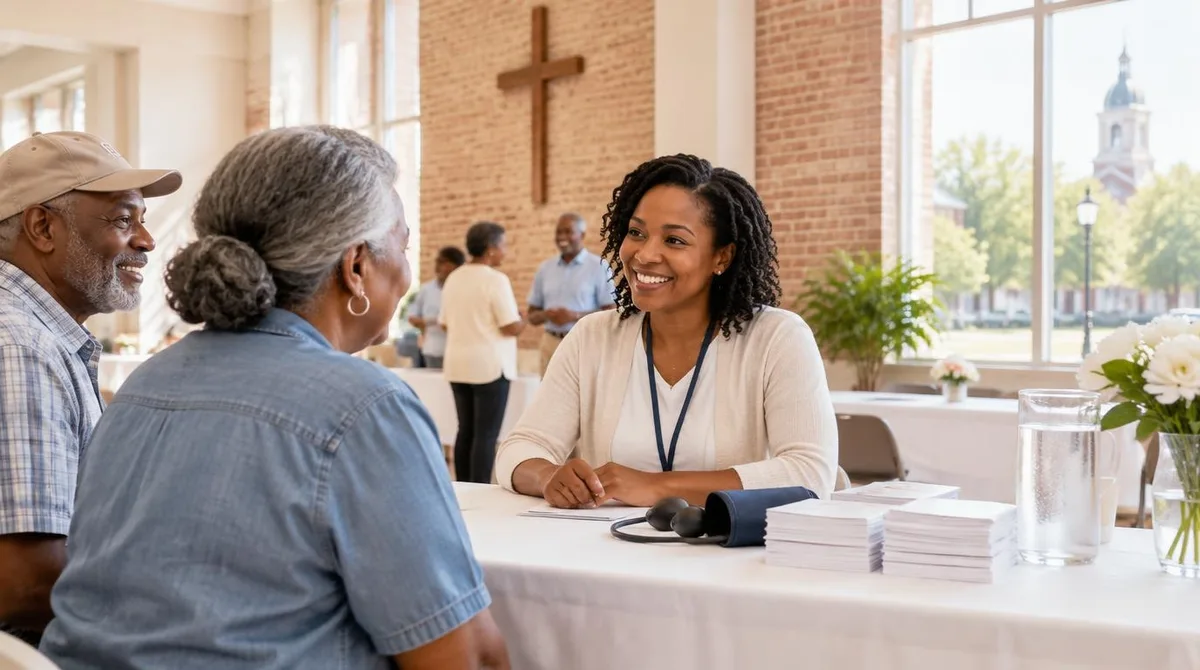
On a Saturday morning in Augusta, Piedmont Augusta held a health fair and panel discussion at Tremont Baptist Church, per WRDW/WAGT. The event aimed to bridge the gap between individual health and community awareness. Its stated tools were simple: speakers, conversation, and a room full of neighbors.
What made the morning worth noticing was not the format, which local health fairs use often, but the framing one participant offered. When communities are aware of health standards, she said, the overall standard of living increases. That is a claim about information, not treatment — and it points to why events like this one matter for the people who organize and attend them.
The fair also fits a pattern this publication has followed elsewhere: churches and community groups acting as the places where health information actually reaches people, as in a Whitehaven church's 21 years of health fairs. The community work of carrying knowledge between neighbors rarely makes headlines. It happens in rooms like this one. Readers following this should also see A Whitehaven church marks 21 years with a health fair that names trauma.
What actually happened at the fair?
Piedmont Augusta, a hospital system, convened the event at Tremont Baptist Church in Augusta, Georgia, on the morning of November 21, 2026, according to WRDW/WAGT. It combined a health fair with a panel discussion, and the speakers aimed to connect residents with healthcare experts. Topics discussed included oral health and mental health.
That pairing is worth a second look. Oral health and mental health are two areas where people often do not know where to start, or whom to ask. Putting both on one panel puts two kinds of expertise in the same room with the same audience. Residents could ask questions directly rather than navigating the healthcare system alone to find answers.
Why does 'reach one, teach one' matter here?
The clearest articulation of the event's logic came from Zakia Mabery, founder of C-CAPE and The ONI Project. "It's important because reach one, teach one. What I may know, you may not know," she said, per WRDW/WAGT. "My neighbor may not know. My brother may not know. So what knowledge I have, what knowledge the professionals may have, it can definitely impact the trajectory of your life or someone you love's life."
Read as a model, that is a two-step theory of how health information travels. First, professionals share knowledge with the people in the room. Then those people carry it outward — to a neighbor, a brother, someone they love. The fair is the first step. The second step happens after everyone goes home, and it is the part no institution can do for a community. This connects to our earlier piece, The twelve zodiac work styles, a light read.
It also explains why the location matters. A church basement is a place people already trust and already attend. Holding a panel there lowers the barrier that a hospital lobby or a clinic waiting room can raise. The expertise comes to where the audience already is, instead of waiting for the audience to come to it.
What does an event like this actually change?
Honestly, the honest answer is: awareness, and the possibility of more. The reporting on the Augusta event describes speakers, topics, and one participant's reflection. It does not include attendance figures, follow-up appointments, or health outcomes. Those are the measures that would show whether a morning like this changed anything measurable, and they are not available here.
What the evidence does support is narrower. Residents in Augusta had direct access to healthcare experts on a Saturday morning. They heard about oral health and mental health in plain terms. A local organizer named the mechanism — knowledge moving person to person — that community health advocates have long described. That is a real thing that happened, and it is worth documenting as such.
The limits are worth stating too. One fair, one morning, one panel is not a health program. The gap between a conversation and a changed standard of living is wide, and it is crossed by follow-up: screenings scheduled, questions asked later, information passed on. The event itself cannot close that gap. It can only open the door to it.
Why this matters for women building careers and communities
Many of the people who organize and sustain events like this are women doing unglamored civic work — planning panels, recruiting speakers, filling rooms. Zakia Mabery's role is a case in point: she founded two organizations, C-CAPE and The ONI Project, and spoke at the fair about why the work matters. That is community leadership in its most practical form, and it looks a lot like the leadership this site covers in other settings: identifying a gap, convening people, and naming what needs to change.
For readers weighing whether to start something similar where they live, the Augusta model offers a low-cost template. Partner with an institution that has expertise. Partner with a place that has trust. Pick two topics people actually wonder about. Then let the attendees do what Mabery described: take the knowledge home and teach one.
The next development to watch is simple. If Piedmont Augusta or similar systems repeat the format, and if local reporting follows up on what attendees did with what they learned, the story moves from a good morning to a measurable one. Until then, the fair stands as a documented example of the first step — knowledge, offered in a trusted room, on a Saturday morning in Augusta.