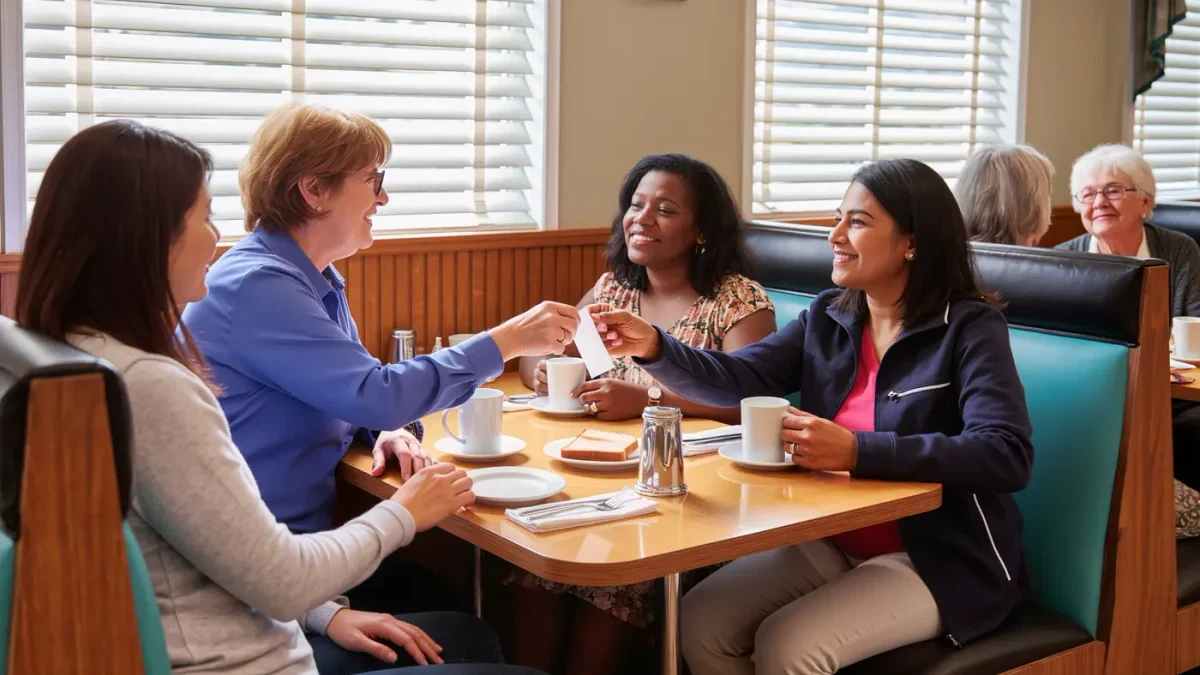
The two formats solve different problems, and confusing them costs money. In-person business clubs, chapter organizations such as BNI or the National Association of Women Business Owners, sell repeated contact, which is what produces referrals; online groups, from Slack and Circle communities to large forums, sell reach and speed, which is what produces answers, leads, and market signal. Women own close to 40 percent of US businesses, per analyses of the Census Bureau's Annual Business Survey, and the stage of the business usually decides which format pays: online first for information, in-person once referrals and contracts matter.
This guide compares the two on cost, time, and output, and offers a split that works for most owners. It is general information, not business advice.
What does an in-person business club actually deliver?
Referrals, accountability, and local standing. Chapter-based clubs meet weekly or monthly on a fixed schedule, and their mechanism is repetition: the same twenty to forty members hear each other's pitches until referring work inside the group becomes reflex. That is why attendance rules in referral clubs are strict, and why members who treat attendance as optional see no return. For women business owners, the secondary product matters as much: a room where the default network is other women owners changes whose referrals circulate. The costs are annual dues, often a few hundred to about a thousand dollars, plus per-meeting costs and the hours, typically two to four a month at minimum.
What does an online business community actually deliver?
Speed and scale. A well-run online group answers a question about a contract clause, a pricing problem, or a tool within hours; surfaces customers directly; and connects owners across geographies and industries, which matters for niche businesses with no local peer set. The failure mode is equally structural: conversations without faces produce weak ties, and weak ties produce advice, not referrals. Paid online communities, typically tens of dollars a month, can outperform free ones on signal-to-noise because the paywall filters for owners with real businesses. The time cost is elastic and dangerous; the feed always offers one more thread.
Which one fits which stage of the business?
| Stage | Better fit | Why |
|---|---|---|
| Pre-revenue, validating an idea | Online communities | Fast, cheap feedback from owners who have solved the same problem |
| First customers, local service business | In-person club | Local referrals are the channel; repetition builds the trust that converts |
| Growing, hiring, first subcontractors | Both | Operations questions scale online; partnerships and credibility stay local |
| Established, seeking contracts or capital | Club plus association | Procurement and lending run on introductions, which online groups rarely generate |
How do you judge a club or a community before committing?
- Audit the membership. For clubs: are members' customers your customers? For online groups: are the active posters owners, or sellers marketing to owners?
- Count the exits. Ask how many members joined and left in the past year in a club; ask a moderator what the spam and self-promotion policy is online.
- Price the total. Dues plus meetings plus travel for the club; subscription plus attention for the group. The attention line is usually the bigger one.
- Run a quarter. Commit to ninety days of full participation and count outputs: referrals received, referrals given, questions answered that changed a decision.
Can online groups really replace local networks for women owners?
Not yet, and the reason is structural rather than sentimental. Referral businesses run on trust, and trust forms faster with repeated in-person contact, the same social-capital dynamic that explains why personal contacts fill so many jobs. Online groups compress information asymmetry brilliantly, prices, contract norms, vendor reputations, and for owners outside major metros they are often the only peer set available. But the local chamber breakfast, the referral club, and the NAWBO chapter still control much of the local contract flow, including supplier-diversity work that requires a human introduction. The practical answer for most owners is one of each, run with a schedule that caps the online half before it eats the working week.
What does the Small Business Administration add to either path?
A free layer under both. The SBA's resource network, Small Business Development Centers, SCORE mentoring, and more than one hundred Women's Business Centers, offers advising, training, and sometimes lender introductions at no charge, funded by the federal government. It does not replace peer community; it supplies expert review, business-plan pressure-testing, and loan-package help that peer groups cannot. Owners who combine an SBA resource partner with one paid online community and one in-person commitment get three different things, expertise, information, and referrals, without paying three times for the same one.
What does a realistic first year in a club look like?
Six months of giving before twelve months of getting, and the sequence matters more than the club. In the first quarter, the job is attendance and specificity: show up every time, and learn to name the exact customer wanted, bookkeepers who serve restaurants, not small businesses, so that other members can actually route work. In the second quarter, the job is contribution: passing two or three qualified referrals outward, because referral economies run on reciprocation and the member who gives first is remembered first. By the third quarter, a role opens up, membership committee, event lead, visitor host, and taking it multiplies contacts the way nothing else in the format does. The owners who report strong club returns describe essentially the same arc, and the ones who quit in month five, citing no referrals yet, reversed it: they expected the harvest before planting. The one-year ledger closes the question, referrals in, referrals out, hours spent, and for most local service businesses the arithmetic lands on renewal.