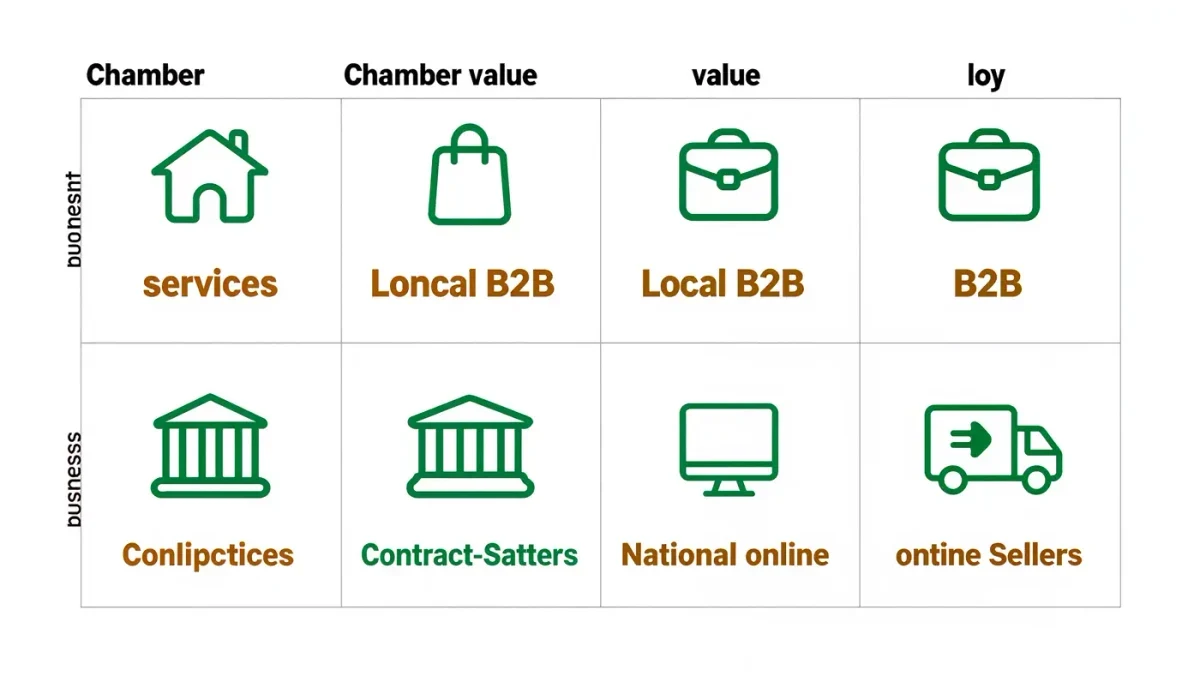
A local chamber of commerce is a membership association of area businesses that sells three things: referral flow, visibility with local government, and a calendar of events where buyers actually appear. Thousands of chambers operate across the United States, most as private nonprofits with annual dues that commonly run a few hundred dollars for small businesses, and the Small Business Administration separately funds Women's Business Centers, more than one hundred nationwide, which provide free advising rather than networking. For a woman business owner, the chamber question is arithmetic: if local businesses, consumers, or municipal contracts are the customer base, membership pays; if customers are national or online, it mostly does not.
This guide covers what chambers deliver, what dues buy, and how to evaluate a specific chamber before paying. It is general information, not business advice.
What does a chamber membership actually include?
Four working parts, and their quality varies more between neighboring chambers than the brochures admit.
- Referral programs. Many chambers route consumer inquiries for vetted local businesses to members, which for service businesses can be the direct return.
- Events and ribbon cuttings. Monthly mixers, luncheons, and grand-opening ceremonies, the visible product, useful exactly to the extent that members are customers.
- Advocacy. Chambers lobby municipal and county governments on regulations, permits, and procurement, and membership is a seat at that table.
- Listing and discounts. A directory listing, and member-to-member discounts on insurance, shipping, and services.
How much does it cost and who should join?
Dues at most local chambers scale with employee count, with small-business tiers commonly in the range of a few hundred dollars a year; large metros run higher. The membership math is simple: estimate the annual value of one or two new local customers against the dues plus the hours. Restaurants, clinics, contractors, agencies, and professional practices with local buyers clear the bar easily. E-commerce and national-service businesses usually do not, and should route the same money to an SBA resource partner, which is free, plus one industry association instead.
| Business type | Chamber value | Better complement |
|---|---|---|
| Local consumer services | High, referrals and events reach buyers directly | Women's Business Center advising on growth |
| B2B with local clients | High, mixers are the sales channel | Industry association for credibility |
| Seeking municipal contracts | High, advocacy and procurement visibility | Supplier-diversity certification |
| National or online customer base | Low | SBA advising plus trade association |
How do you judge a specific chamber before joining?
- Attend two events first. Most chambers let prospective members attend once or twice. Count buyers, not badges.
- Read the last year's calendar. A chamber that ran eight ribbon cuttings and no policy work is an events business, not an advocacy organization.
- Ask for the referral stats. Serious chambers track inquiries routed to members and will say so; evasiveness is an answer.
- Talk to three members in similar industries, and ask what closed business they can trace to the membership.
Do chambers serve women owners specifically?
Unevenly, which is why many women owners stack a chamber membership with a women-focused organization such as a NAWBO chapter or a Women's Business Center relationship. Chambers historically reflect their local business establishment, and in some cities the leadership and the deal flow still skew that way; in others, chambers run women's divisions and young-professional groups that function as networks inside the network. The practical test is the same as for any chapter organization: look at who chairs the committees and whose referrals circulate. If the answer is unsatisfying, the women-focused organization carries the peer load, and the chamber is kept purely for its referral and advocacy functions, which is a reasonable division of labor and a common one.
How do you get value in the first year?
By holding a role. Chamber returns concentrate among members who join a committee, ambassador programs, or an event-organizing slot, because the title manufactures introductions at member-grade speed. Passive members who attend the annual dinner and renew quietly are the chamber's margin, not its market. A fair first-year commitment: attend monthly, take one committee role, track closed business against dues in a running log, and decide the renewal from the ledger rather than from the renewal invoice's urgency.
How do chambers compare with other local options?
The local landscape holds more than one door, and they are not substitutes. A chamber delivers breadth, buyers across every industry in one calendar, and a line to city hall. A women's business organization, a NAWBO chapter or a peer roundtable, delivers depth among owners dealing with the same financing, certification, and credibility questions. A Women's Business Center delivers expertise at no cost, advising on loans, projections, and certifications. A referral club delivers a single-channel, high-commitment version of the chamber's networking function. The efficient stack for most owners with local customers is two paid commitments at most, a chamber for reach and one focused group for peer support, with the free SBA resource layered underneath. The common error is paying for three networking memberships and attending none of them well; breadth without attendance returns nothing in any of these formats. The renewal calendar, reviewed once a year against the closed-business ledger, prunes the stack faster than any rule of thumb.