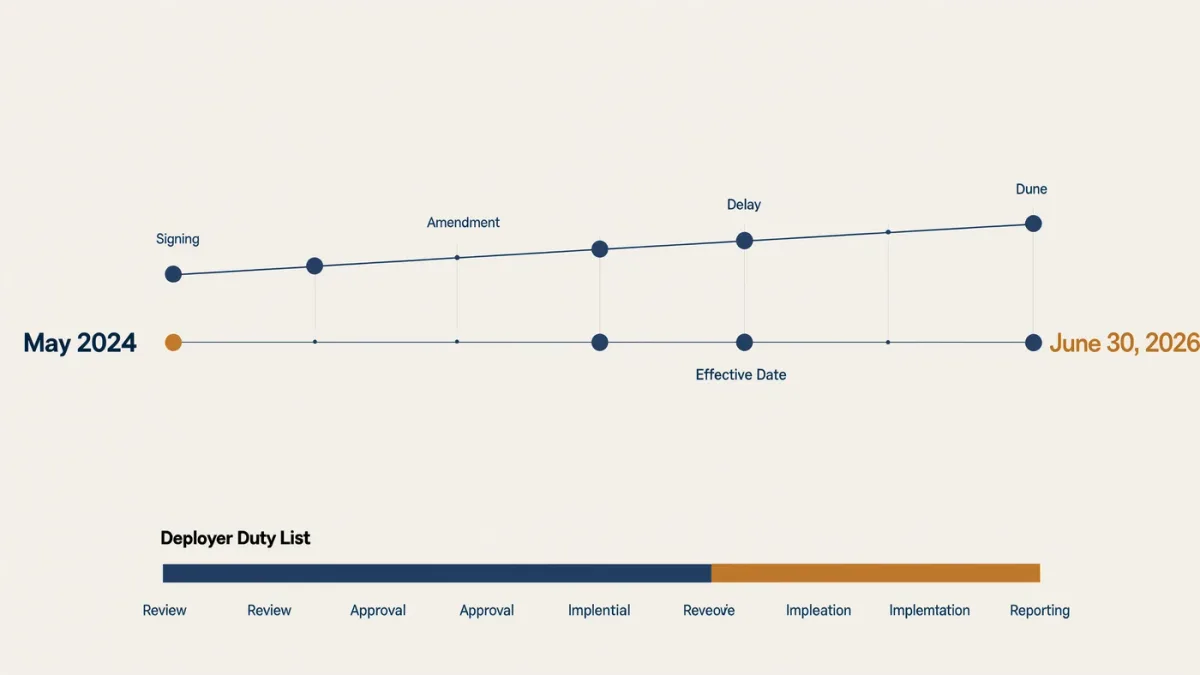
Colorado repealed and replaced its first-in-the-nation AI law on May 14, 2026, when Senate Bill 26-189 was signed into law, per Littler's analysis of the legislation. The original Colorado AI Act, set to regulate high-risk AI in hiring after two delays, never took effect: the new Automated Decision-Making Technology law starts January 1, 2027 with scaled-back employer obligations.
What happened to the original Colorado AI Act?
The 2024 law, SB 24-205, was originally written to take effect February 1, 2026, the first state statute to treat hiring algorithms as high-risk systems requiring impact assessments and notices. During a special session in late 2025, lawmakers pushed the date to June 30, 2026. Then, on May 1, 2026, SB 26-189 was introduced to repeal the act outright, per the law firm Proskauer's tracker, and it was signed thirteen days later. The result: no gap of enforcement, because there was nothing yet to enforce.
What does the new law require of employers?
The replacement law regulates automated decision-making technology in employment decisions — hiring, firing, promotion — through an individual-decision accountability model rather than the old high-risk-system framework, per Jackson Lewis's analysis. It requires staged notices to applicants and employees, adds recordkeeping duties, and moves enforcement to the Colorado Attorney General under consumer-protection provisions, with rulemaking underway through the AG's AI page. Obligations are lighter than what the 2024 act would have imposed.
Why it matters for women in hiring pipelines
Automated resume screens and video assessments sit exactly where the broken rung begins, and the research consensus is that tools trained on past hiring reproduce past skew. Colorado's retreat changes the compliance picture but not the underlying exposure: New York City's Local Law 144, in force since July 2023, still requires bias audits for automated employment decision tools. For a woman job seeker, the practical protection right now is disclosure-based — notice when a tool is being used — and the practical move is to ask, in any interview process, whether an algorithm screens applications and what human review follows.
What changes on January 1, 2027?
Three things, mainly. Covered employers using automated decision-making technology in employment will owe staged notices — telling workers when a tool is involved in a decision about them — and will need records showing how individual decisions were made. Enforcement runs through the Attorney General rather than private lawsuits. And because rulemaking is still underway at the AG's office, per its AI page, the exact compliance mechanics are not final; watch that process, not the statutory text alone, for what audits, notices, and timing will actually look like when the law lands.