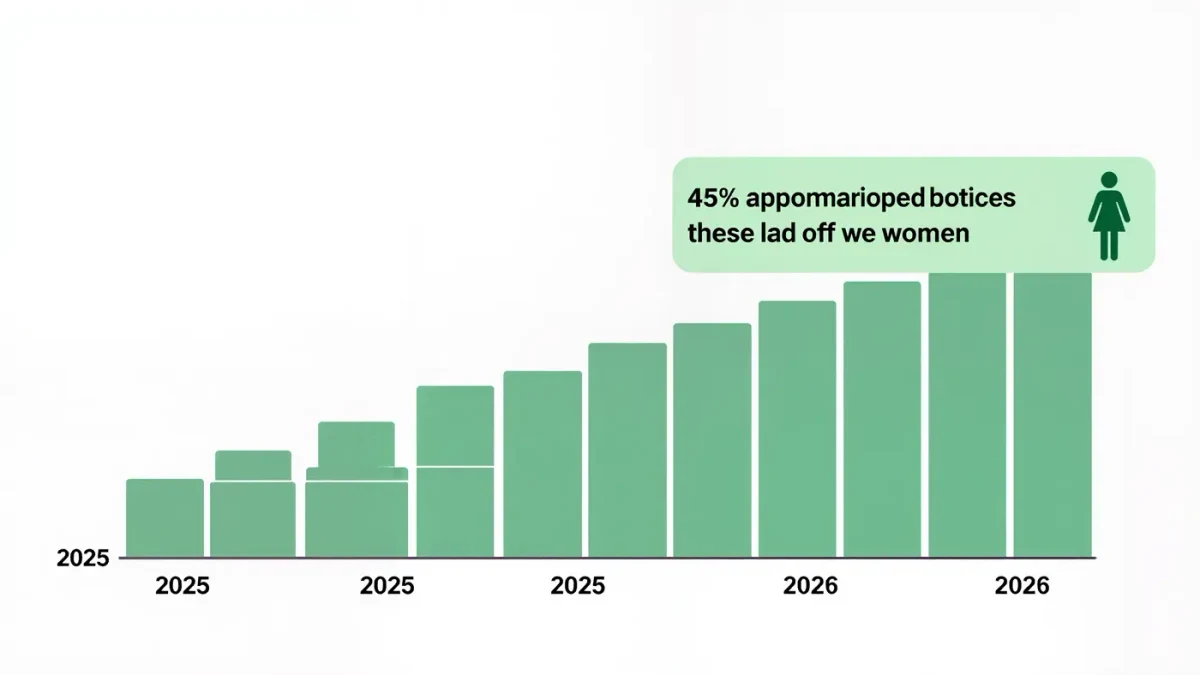
US technology companies announced 139,156 job cuts in the first half of 2026, up 83 percent from the same period a year earlier, per Challenger, Gray & Christmas data — and women, who hold roughly a quarter of tech jobs, accounted for close to 45 percent of those laid off in the major cut periods, per WomenTech Network's 2026 statistics. The first quarter alone saw 81,700 cuts, the most in a single quarter since early 2023.
What is driving the 2026 cuts?
Artificial intelligence is the first-cited reason. AI was named the leading cause of announced job cuts for months running in 2026, per Challenger's monthly reports, and Reuters reported on July 6, 2026 that companies are cutting roles as investment shifts toward AI infrastructure. Microsoft joined the wave with about 4,800 cuts, roughly 2 percent of its workforce, per Reuters. The pattern is structural rather than cyclical: spending is moving from headcount to compute.
Why the cuts land harder on women
Women hold roughly 26 to 28 percent of US tech jobs, per industry workforce statistics, so a layoff pool that is 45 percent women means women are being cut at close to twice their representation. Two mechanisms compound it. Support, program management, and people-adjacent technical roles — fields with higher shares of women — are earlier targets when companies cut everything except core engineering. And the broken-rung problem documented in the Women in the Workplace 2025 report means fewer women have reached the seniority that typically survives restructuring rounds.
Why it matters for women building tech careers
A rehiring market that favors AI skills is not gender-neutral if access to those skills is uneven; the same LeanIn.Org-McKinsey report found fewer entry-level women than men encouraged to use AI tools at work. The practical response for a woman in tech right now is to price her skills against the shift: internal moves toward AI-adjacent work carry more protection than tenure in a cost center. For women laid off, the data argues against waiting out the same employer — rehiring in 2026 concentrates in AI, data infrastructure, and applied machine learning, and the fastest route back is usually a certification plus a smaller company rather than a return to the large-firm ladder that just cut her. One number worth watching for the rest of 2026: whether the rehiring share of women matches the layoff share. If it does not, the cuts will register in the next Women in the Workplace report as a step backward that took only two quarters to create and years to reverse.