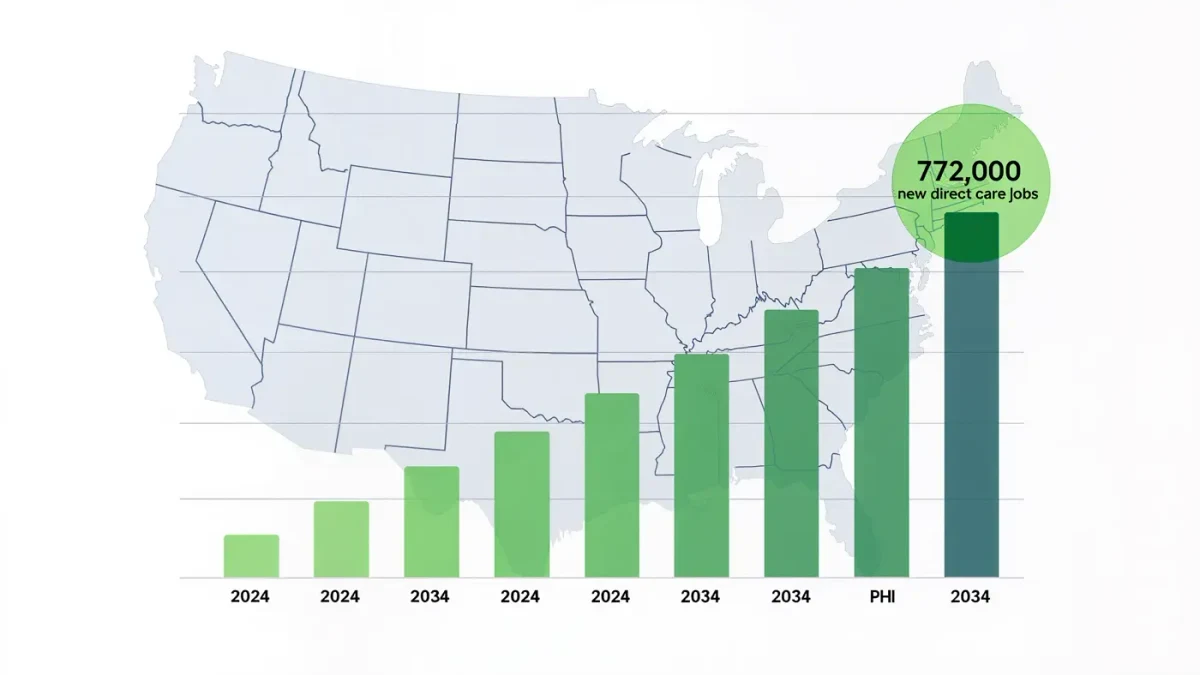
Home health and personal care aides will add more jobs than any other occupation in the US economy through 2034 — roughly three-quarters of a million positions, per the Bureau of Labor Statistics employment projections released in late August 2025 — and the direct care workforce behind that growth remains overwhelmingly female, per PHI, the direct care research organization, which projects more than 772,000 new direct care jobs over the decade.
What do the projections show?
The BLS projections, covering 2024 through 2034, put home health and personal care aides at the top of the list for total job growth, expanding at roughly 17 to 21 percent — far faster than the average for all occupations. Demand is driven by the aging of the population: millions of Americans are reaching the ages where paid care at home replaces facility care. The occupation is already one of the largest in the country, and it gets bigger from here.
What does the work pay?
Not much, and that is the tension in the numbers. Median pay for home health and personal care aides runs in the low thirty-thousands per year, per the BLS Occupational Outlook Handbook, a wage level that care advocates note barely covers living costs even as demand climbs. The paradox of the care economy in 2026 is a labor market that cannot fill its fastest-growing jobs without raising wages that have been suppressed for decades, in a workforce that is disproportionately women of color and immigrants, per PHI's analyses of the direct care workforce.
Why it matters for women's careers
Two different careers stories run through these numbers. For the women already doing direct care work, the projections are leverage: an occupation employers cannot staff at current wages is one where organized pressure, wage standards, and unionization efforts have the strongest factual case. For women planning longer careers, the care economy is also a management and entrepreneurship lane — agencies, care coordination platforms, and staffing firms are growing on the same demographic curve, and the owners and operators deciding how care gets delivered shape the wages rather than just receiving them. The demand side of this market is guaranteed by demography; the open question is only who captures the value.
What should job seekers watch next?
The BLS updates its projections annually each summer, and the care occupations have held the top growth spots in successive vintages. Watch state-level wage rules for care workers and any federal staffing standards for home care agencies, because those set the wage floor in an occupation where market demand alone has not.