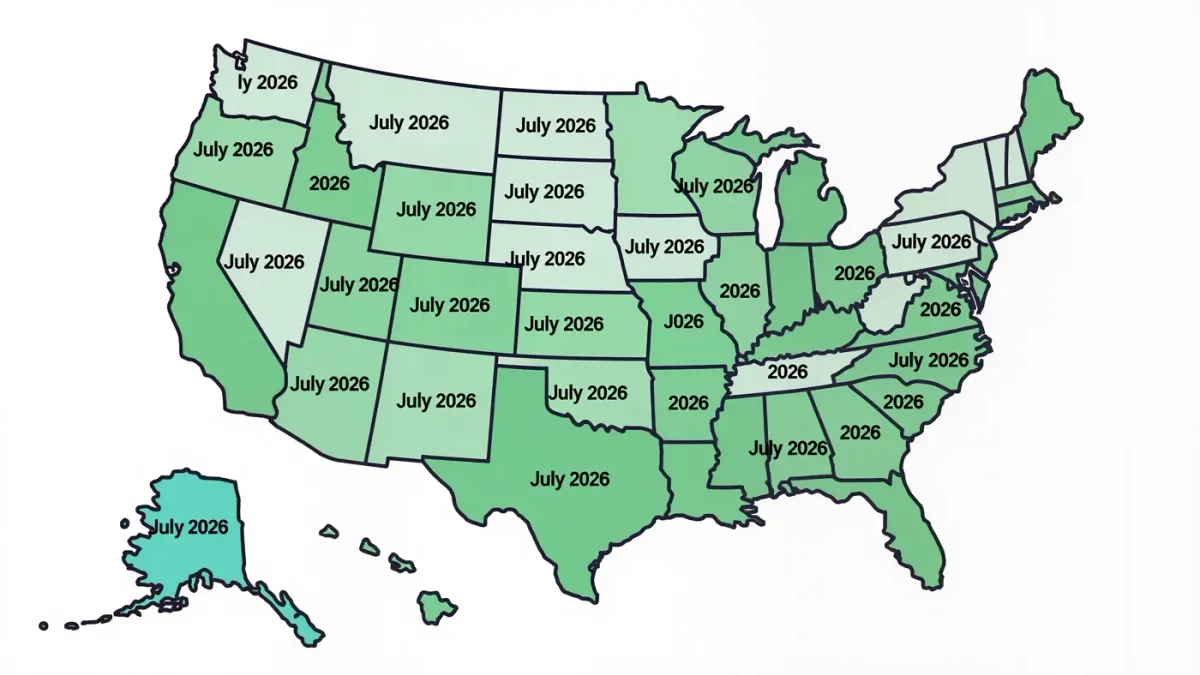
About 18 states now have pay-transparency laws on the books, and the map grows again on July 1, 2026, when Virginia and Maine begin requiring good-faith salary ranges in job postings. Both laws were enacted in 2025, per Ogletree Deakins' analysis of the two bills, joining a disclosure wave New Jersey entered on June 1, 2025.
This article publishes information about state employment law; it is not legal advice for any specific employer or job search.
What do the new Virginia and Maine laws require?
Virginia's HB 636, approved April 22, 2025, covers every employer in the state regardless of size, requires a good-faith wage or salary range in every posting — internal and external, including promotions and transfers — bars salary-history questions, and gives applicants a private right of action for violations, per the Virginia Legislative Information System. Maine's companion measure takes effect the same July 1, 2026 date, per Ogletree Deakins. The private-right-of-action detail is the one many summaries skip: in Virginia, a violated applicant can sue, not just file a complaint.
How did the 2025 laws change the baseline?
New Jersey's amendment, effective June 1, 2025, applies to employers with 10 or more employees and requires a good-faith salary range plus a general description of benefits in each posting, per the New Jersey Department of Labor — which also advises against unreasonably wide ranges. Vermont's law covers employers with five or more employees; Illinois has required pay scales in postings since January 1, 2025, per the Illinois Department of Labor. The pattern is consistent: thresholds are shrinking, and ranges must appear in the posting itself, not on request.
Why it matters for women negotiating pay
Posted ranges move the hardest information problem in a negotiation. A woman applying in a covered state can anchor to the posted range before the first interview, and a range that looks wide or low is itself a signal about the employer. The state-by-state patchwork still leaves gaps — remote jobs, employers just under the threshold, and states with no law — but the direction since 2025 has been one-way, with employment firms including Jackson Lewis tracking continued expansion into 2026.
What should a job seeker actually do with a posted range?
Treat the top of a posted range as a real number, not a decoy. Apply the New Jersey labor department's own logic: a range so wide it is meaningless is a warning. And in states where disclosure is not required, the posted ranges from comparable covered-state listings are the closest public benchmark available.