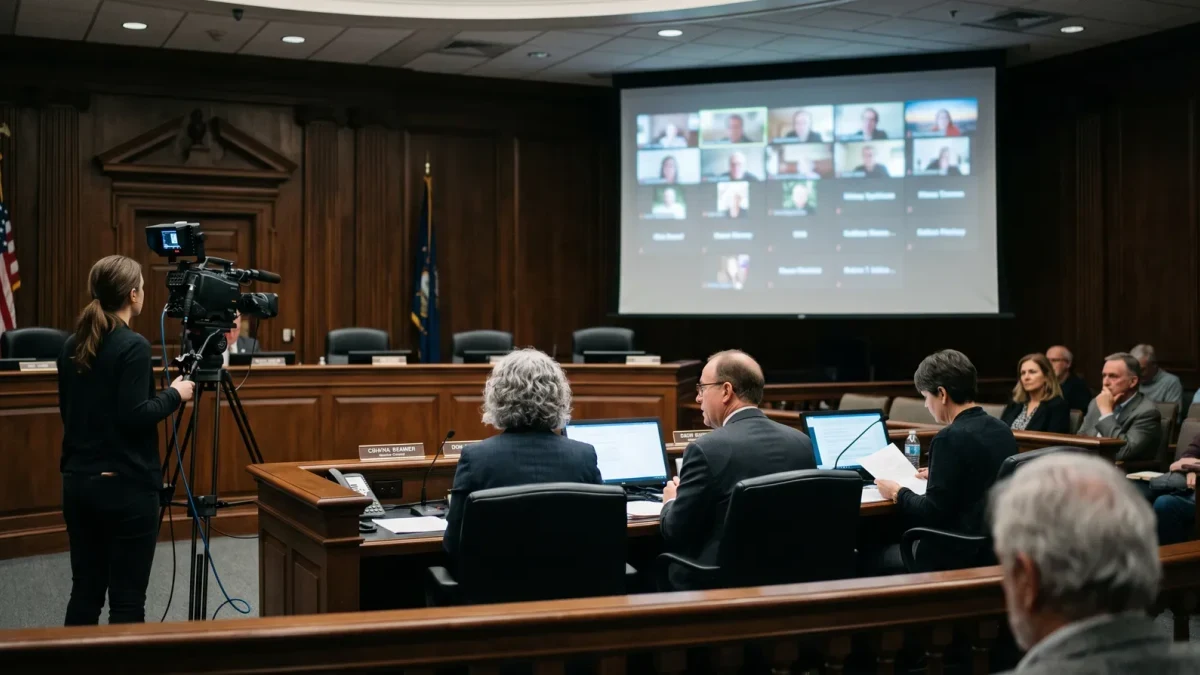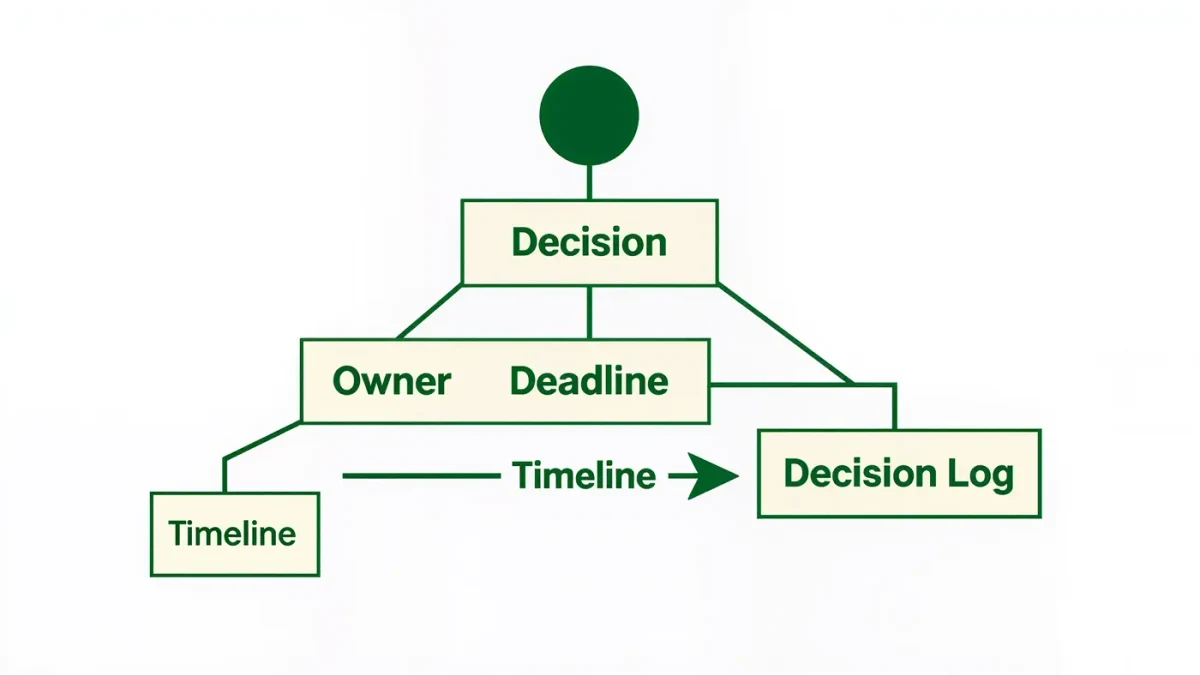
A meeting produces decisions when three things are named before it starts: the decision to be made, the person who makes it, and the deadline attached to it. Everything else is information exchange, which is legitimate but cheaper in writing. The stakes are measured in time: American workers spend a large share of the week in meetings, and surveys of at-work time use, including Microsoft's Work Trend Index published in 2024 covering 31,000 workers, found meeting volume rising faster than document creation, with knowledge workers widely reporting overload. The chair is the person who can reverse that trend for one team.
This guide covers the mechanics of chairing decision meetings. It is general management information, not advice about any specific organization.
What belongs in a decision meeting at all?
Only questions where people with different information must converge on one choice. Status updates, reviews of written material, and FYI briefings do not qualify, because no convergence is required; they belong in documents. A useful test the chair can apply in ten seconds: if the outcome is a sentence of the form we will do X by Y, and someone in the room would otherwise disagree, it is a decision meeting. Otherwise it is not.
Women managers have a specific interest in the discipline, because the glue work of badly run meetings, note-taking, scheduling, chasing follow-ups, falls to women disproportionately, a pattern documented across the McKinsey and LeanIn.Org Women in the Workplace series, which found in 2024 that women managers spend more time and energy on employee support and team maintenance than men managers. A chair who runs tight meetings assigns that work by rotation, not by gender.
What does the chair do before the meeting?
Four things, in a short written agenda circulated at least a day ahead:
- State the decision as a question the meeting will answer, for example, which vendor do we sign by the 15th.
- Name the decider for each question, one person, not the room.
- Attach the material as pre-reading, with a note that the meeting will not summarize it.
- Invite only the people whose information or veto changes the answer.
The named decider is the step most teams skip, and it is the one that prevents the classic failure: a discussion that circles because everyone thinks consensus is required when it is not. Consensus is expensive and rarely necessary; consent of the people with the relevant information usually is.
What does the chair do during the meeting?
Opens with the decision question, manages airtime, and closes with a spoken record. In practice:
- Restate the question and the deadline in the first minute.
- Ask the quietest relevant person first, so the frame is not set by the first speaker.
- Interrupt summaries of the pre-reading politely and once; the second time, the meeting learns.
- When discussion loops, ask the decider what remaining fact would let them choose, and go get that fact.
- In the last five minutes, read the decisions aloud: what, who owns it, when it is due, written where.
Airtime management is where bias does its quiet work. Research on group discussion has long shown that airtime skews toward seniority, volume, and gender unless actively managed. A chair who tracks who has spoken, and who calls on the person with the relevant expertise rather than the fastest talker, gets better decisions, not just fairer ones.
How are disagreements handled without derailing the room?
By converting them into named risks rather than re-argued positions. The chair's move is to say: what fact would settle this, who can get it, and by when. Disagreements that rest on values rather than facts get sent to the decider explicitly, as in, this is a values trade-off, it is yours to make by Friday. That sentence, said calmly, is most of what chairing is.
For women chairs there is a documented double standard in being interrupted and in being read as either too soft or too sharp. The structural defenses work better than stylistic ones: the written agenda does the asserting in advance, the spoken record at the end does the enforcing, and the process, not the person's tone, carries the authority.
What happens after the meeting?
The record. Decisions land in a shared log within a day, owned by a rotating note-taker, and the chair checks follow-ups once, at the deadline, rather than daily. Meetings that produce a written decision generate the next meeting's pre-reading for free, which is how the cycle shortens.
| Meeting type | Right vehicle | Output |
|---|---|---|
| Status updates | Written channel | No meeting |
| Document review | Comments in the doc | Written revisions |
| Decision meeting | 30-45 minutes, pre-read | Decision, owner, deadline |
| Dispute | Named decider plus facts | Ruling or fact-finding task |
How long before a team notices the difference?
Two or three cycles, in most accounts. The first tightened meeting feels abrupt; by the second, participants arrive having read the material because not reading it now has visible consequences; by the third, the decision log is doing enough work that one recurring meeting per team usually disappears. The chair's discipline is the input, and the team's returned hours are the output. That trade is the entire argument.