Eclipse season is astrology's favorite plot twist: twice a year, for a few dramatic weeks, the folklore says the lights flicker and life reroutes itself. This article treats all of that as entertainment. No prediction is made, astrology is not presented as fact, and nothing here is advice about changing your actual job. What is offered is a moody seasonal frame and a set of reflection questions that work just as well under an ordinary cloudy sky.
As always, this page stays inside Heroines' fenced horoscope corner, far from the site's journalism. No statistics, no companies, no real people — only an old sky story and a notebook prompt.
What is eclipse season in the folkloric imagination?
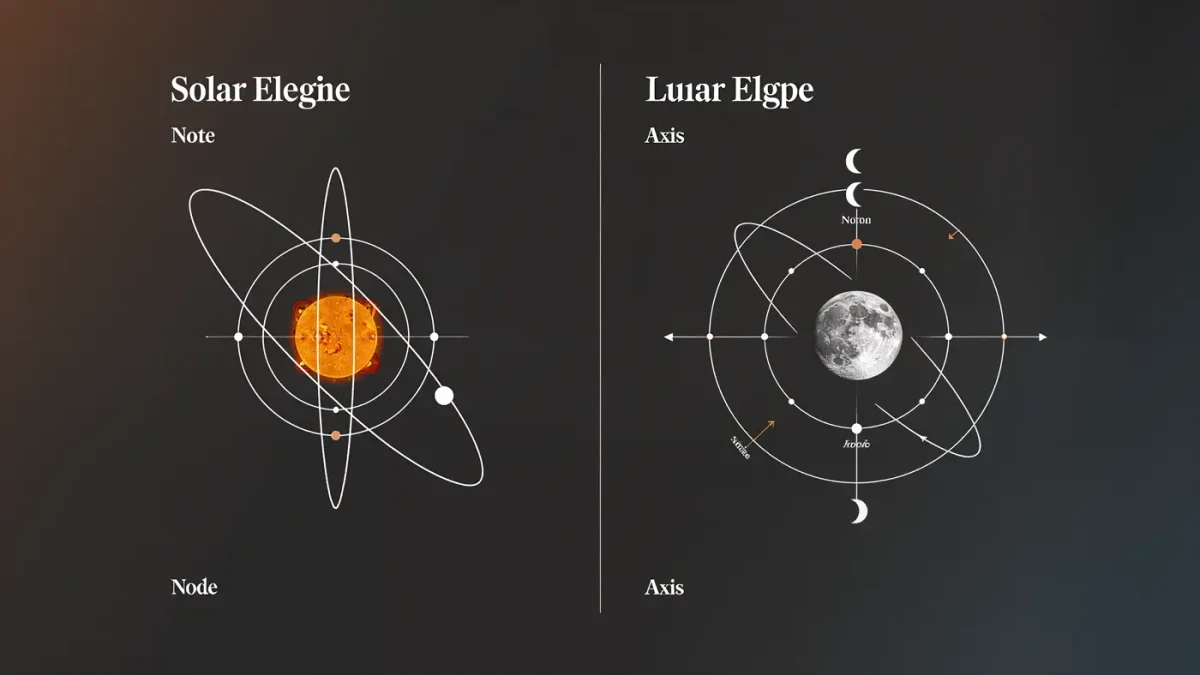
Astronomically, an eclipse happens when the sun, moon, and earth line up and one light temporarily blocks the other — a measurable, scheduled, entirely impersonal event. Folklore, being folklore, disagrees: eclipse season, the weeks around these alignments, is cast as a time of sudden endings, abrupt beginnings, and doors that were firmly locked swinging quietly open. It is wonderful material. The sky performing a slow blink twice a year is exactly the kind of coincidence storytellers cannot resist, and the tradition around it has become a standing invitation to think about change — scheduled changelessness interrupted, on cue.
Why use an eclipse as a reflection prompt?
Because change is hard to look at directly, and an eclipse is a metaphor with a built-in schedule. Most people carry a vague question about work — is this still the right path, what would I try if I could, what am I done with — and never quite find the evening for it. An eclipse season gives that evening a date, a mood, and a bit of theater. The ritual borrows the sky's drama the way a dinner party borrows candlelight: nothing is illuminated by the flame, but everyone sees better.
Which questions suit an eclipse-season evening?
On the temporary darkness
- What in my working life feels dimmed right now — and is it truly fading, or just in shadow for a season?
- Which of my routines would I miss if it vanished tomorrow, honestly?
- If a light I rely on went out for an hour, what would I do first in the dark?
On the doors that swing
- What door have I been knocking on politely, and what would a bolder knock sound like?
- Which opportunity am I keeping half-open just in case — and is the draft worth it?
- If a change happened to me rather than by me, what would I hope it is?
On coming back into the light
- When the ordinary light returns, what do I want to still be true?
- What would I begin this season if nobody, including the sky, was watching?
How do you keep the ritual from turning into a forecast?
Finish the evening and release it. The questions are the substance; the eclipse is the stagecraft, and stagecraft should never issue instructions. Regret arrives when a playful ritual starts posing as an omen — when a job question asked by candlelight gets answered by a planet instead of by a person. Use the season for its one honest gift: a dramatic, recurring, entirely free excuse to sit with your own questions. Then make any real decisions the way real decisions are made — in daylight, with real information, and not on the advice of a shadow.
The eclipse passes on schedule and so does the season. The questions, if they were good ones, stay lit on their own.