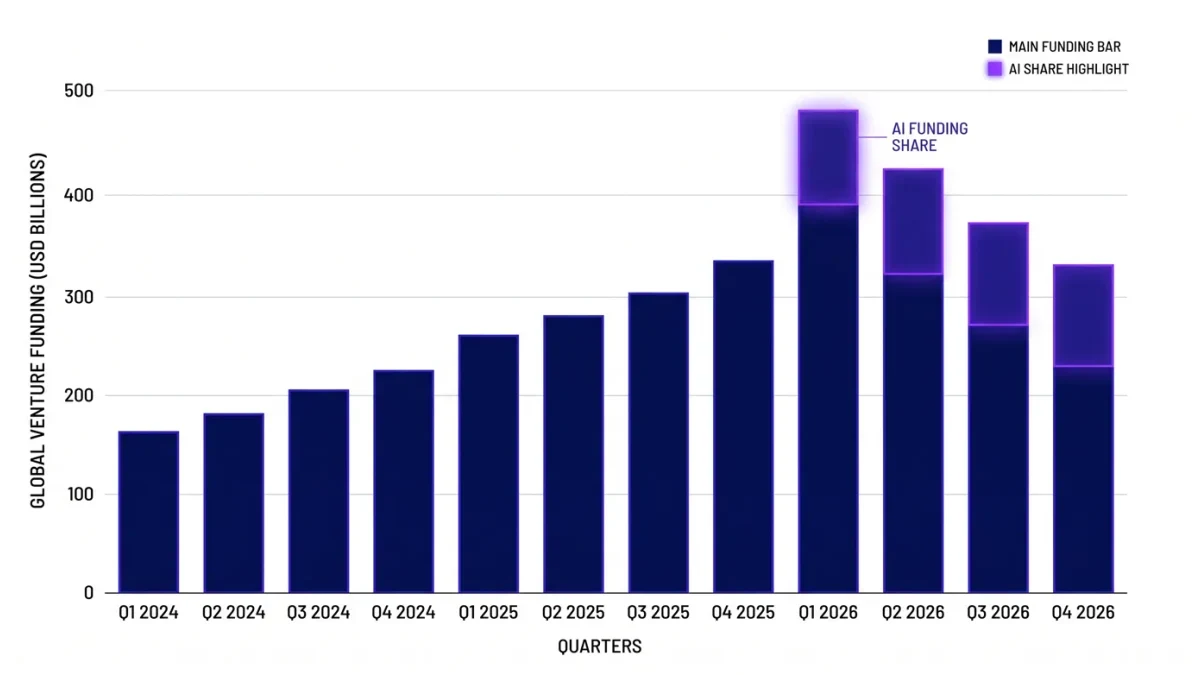
Most woman-founded companies in the United States are bootstrapped, and the venture data explains why: companies founded only by women received under 2 percent of venture capital dollars in 2024, per PitchBook's annual tally. Bootstrapping means slower growth but full ownership; venture means speed in exchange for control and a fundraising process that the numbers show is harder for women.
The comparison below lays out what each path actually costs and returns, so a founder can weigh both against her own situation.
What does bootstrapping actually give up and give back?
Bootstrapping keeps 100 percent of equity and 100 percent of decision-making with the founder. The trade is growth speed: without outside capital, a company funds product, hiring and marketing from revenue, which usually means a smaller, slower business and a founder salary that arrives late.
The model works best when a business can charge early and grow from customers rather than capital — services, agencies, specialized software with paying users from the start. It struggles when a product needs years of development before the first dollar. Bootstrapped founders also carry the personal risk of savings and credit lines, which compounds for founders with less household wealth to draw on.
Why does the venture path look different for women founders?
The percentages have barely moved for a decade. Women-only founding teams took under 2 percent of U.S. venture dollars in 2024, per PitchBook, a share that has stayed near that level since the mid-2010s. Mixed-gender founding teams add a few points more, but the combined total remains small relative to women's share of business ownership overall.
The practical consequence is not only less money. It is more time fundraising, more dilution per dollar raised, and more pressure to show traction early. A founder who budgets six months for a seed round based on average timelines may need longer, and that gap shapes everything from runway planning to hiring.
How do the two paths compare side by side?
The choice comes down to ownership, speed, risk and exit options, and each column carries a real cost.
| Factor | Bootstrapped | Venture-funded |
|---|---|---|
| Equity held by founder | 100 percent | Declines with each round | Typical growth pace | Set by revenue | Set by the raise schedule | Pressure to exit | None required | High; funds need returns | Access for women founders | Open to anyone with customers | Under 2 percent of 2024 dollars, per PitchBook |
What questions settle the decision?
A founder can pressure-test the choice with four questions before committing either way.
- Does the business need years of unpaid build time, or can it charge customers within months?
- Can the founder personally absorb a long stretch without salary, and for how long?
- Is the goal a durable company she controls, or a fast-scaling one an investor can sell?
- Is she prepared for a fundraising process the data shows is longer and thinner for women?
If the answers point to control and early revenue, bootstrapping fits. If the market rewards speed above all and the founder accepts dilution, venture is the instrument — pursued with the timeline discount applied.
Is there a middle path?
Yes, and many women founders take it. Revenue-based financing, small-business loans, grants and customer prepayment can fund growth without a term sheet. The Small Business Administration's funding programs cover loan options and preparedness tools on the government side, and a growing set of angel groups and funds invest specifically in women-founded companies. A bootstrapped company can also raise later, from a stronger position, once revenue proves the model.
The funding choice is not a verdict on ambition. Plenty of durable, profitable companies were built without a single round, and the founders kept the keys.
What should a founder do in the next month?
Whatever the direction, three steps apply now: model the business both ways with realistic, slower fundraising timelines for the venture case; price the product as if bootstrapped, because revenue discipline helps in both worlds; and talk to founders who run each model about the year-two experience, not the launch story. The decision deserves numbers, not narratives.
How does the choice change daily life?
The two paths produce different founder calendars, and founders underestimate that difference. A bootstrapped owner spends most of her week on customers: delivering, selling, invoicing, because customers are the only fuel. A venture-backed founder splits her week between execution and the next raise — investor updates, pipeline meetings, board preparation — and by the Series A the fundraising calendar can consume a quarter of her time.
Neither calendar is wrong, but each demands a different temperament. Founders who find investor conversations draining should weigh that cost honestly, because it recurs at every round. Founders who dread sales should weigh the bootstrap's arithmetic, because there is no version of it without selling. The honest self-assessment belongs in the decision alongside the spreadsheets, and advisors who know the founder's working style can flag a mismatch before it costs a year.