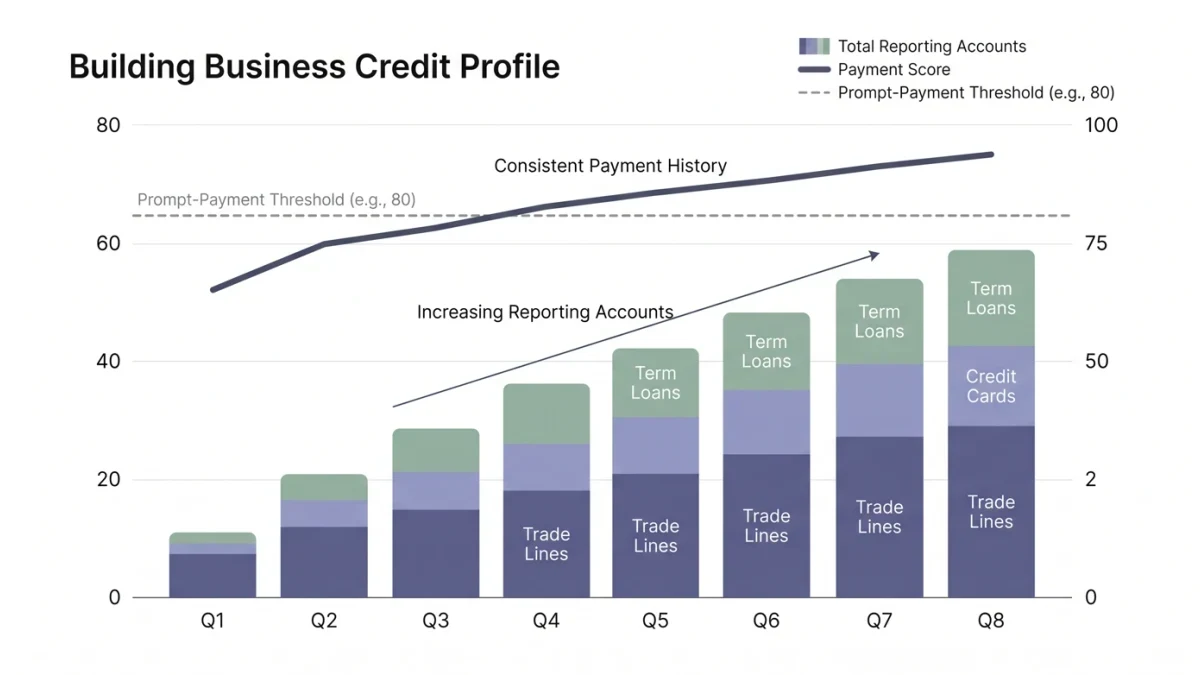
Business credit is a track record kept in the business's own name, and it starts with about one in five U.S. employer firms being women-owned, per the Census Bureau's Annual Business Survey — yet many of those owners finance their companies on personal cards. Building business credit separates the company's borrowing identity from the founder's, unlocking better loan terms, higher limits and supplier credit that a personal score cannot reach.
Credit products and reporting practices vary by issuer and bureau, so founders should confirm details with lenders directly before borrowing.
Why does business credit matter apart from personal credit?
When a lender or supplier checks a business, they can pull a business credit file from bureaus like Dun & Bradstreet, Experian Business or Equifax Business. A strong file means the company — not the founder — is the borrower, which protects personal credit capacity and can lower the interest rates and payment terms a business is offered.
A weak or missing business file pushes lenders back to the founder's personal score, which ties the household to every business debt. For founders who already carry student loans or family obligations, that concentration is a risk worth unwinding early.
What are the first five steps from zero?
The sequence is dull and it works, and each step unlocks the next.
- Form and register properly: an LLC or corporation, plus an Employer Identification Number from the IRS, creates the legal identity lenders look for.
- Open the basics in the business name: a business checking account, a dedicated business phone and a consistent public address, all matching across registrations and listings.
- Get a business credit card or a net-30 supplier account: even a small credit line, paid on time every month, begins generating reported history.
- Confirm reporting: not every vendor reports payments; founders should ask, or choose vendors known to report, so the on-time record actually lands in the file.
- Pay early where possible: business scoring rewards payments before the due date more than personal scoring does.
How long until the file is useful?
Lenders typically want to see six months to two years of reported activity before extending unsecured business credit on the company's merits alone. Early on, founders should expect personal guarantees on loans and cards; those are normal and usually unavoidable for new entities. The goal is to outgrow them.
| Stage | What the business can typically get | What still depends on the founder |
|---|---|---|
| Months 0-6 | Business bank account, starter card, net-30 supplies | Personal guarantee everywhere |
| Months 6-24 | Reported trade lines, small business card limit increases | Most loans under $50,000 |
| Year 2+ | Supplier terms, equipment financing, stronger loan offers | Gradually less, with a thick file |
What mistakes stall the file?
Four patterns show up constantly: mixing personal and business spending so no clean history forms; paying late once and erasing months of buildup; assuming every vendor reports payments; and maxing out the first card, because utilization weighs on business scores much as it does on personal ones.
A fifth is quieter: closing old accounts. Age of credit lines helps the business file the same way it helps a personal score, so the starter card a founder outgrows is often worth keeping open with a small recurring charge.
Do loan programs for women interact with business credit?
They do. The SBA's loan programs work through banks but carry government backing, and lenders still review the business's credit file and finances before approval. A founder with two years of reported, on-time trade lines presents a very different application than one whose business is financially invisible. Community lenders and CDFIs focused on women-owned businesses apply similar logic with more coaching attached.
Business credit is one of the few business assets that gets built by routine. Every invoice paid on time is a deposit into a file the founder never has to think about — until the day it prices a loan.
What should a founder do this quarter?
Three moves: verify that the business's name, address and EIN match everywhere they appear; open or revive one reporting credit line and keep utilization under a third of the limit; and pull the business's file from each major bureau once a year to catch errors early. None of it is dramatic, and all of it compounds.
How do loan denials turn into better applications?
A denial is usable information, and lenders will usually say which factor drove it: thin file, weak revenue, high existing debt or the founder's personal score. Owners who ask — and community development financial institutions in particular will explain — can fix the named factor rather than reapplying into the same wall. A file thin on trade lines is fixed with more reporting vendors; a revenue concern is fixed with time and better margins; a personal score issue has its own well-documented repair path.
Rejected applicants should also reapply within the same institution rather than scattering applications. A lender that said no with reasons often says yes a year later to a founder who addressed every one, and that history of follow-through reads as lower risk.