Executive presence is a tighter tightrope for women because the standard is defined by evaluators in the image of current leaders, and the behaviors that read as confident in men read as abrasive in women, a double bind documented in Catalyst's research and repeated across performance-evaluation studies. Women leaders are more likely to have their judgment questioned and to be told they are too aggressive, per the McKinsey and LeanIn.Org Women in the Workplace 2024 report. Yet presence is also genuinely consequential: leaders with strong communication skills are more likely to be promoted, and the gap between how women and men are coached on it starts early.
This guide breaks presence into trainable components and explains where the double standard operates. It is general information about workplace skills, not a claim that any individual assessment was biased.
What do evaluators actually mean by executive presence?
Three things, though they rarely say them separately. Gravitas: composure under pressure, decisiveness with incomplete information, the ability to absorb a hostile question without defensiveness. Communication: clarity, brevity, and the ability to land one message in a room of distractions. Appearance: the least discussed and most policed component, where women face narrower accepted ranges than men, a finding consistent with Catalyst's work on the double bind. Gravitas is the weight of the three; communication is the most improvable; appearance is where most of the unfairness concentrates.
Where exactly does the double standard bite?
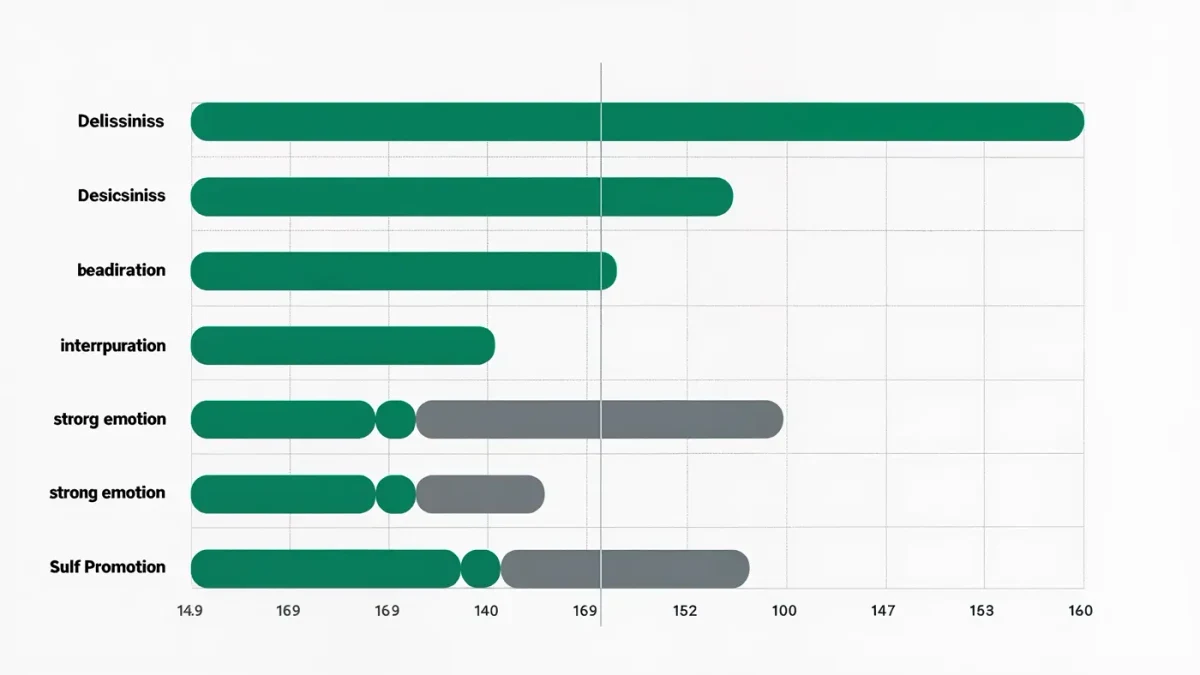
Four behaviors are rated differently by speaker gender in the evaluation research. Interruption of others, read as leadership in men and as rudeness in women. Display of strong emotion, tolerated as passion in men and coded as instability in women. Self-promotion, read as confidence in men and arrogance in women, which is why stated results, rather than adjectives about them, are the safer vehicle. And decisiveness itself: the identical we will do X said by a man reads as command and by a woman is more likely to be challenged, consistent with the questioned-judgment findings in Women in the Workplace 2024.
The practical reading is not that women should shrink the behavior. It is that the packaging and the paper trail have to be stronger for the same behavior to survive the rating.
Which components can actually be trained?
Communication, decisiveness, and composure respond well to deliberate practice, and the training is unglamorous:
- Answer-first structure: conclusion in the first sentence, then two supporting facts, then stop. Most senior audiences hear only the first sentence; put the substance there.
- Timed answers: two minutes for a briefing, thirty seconds for a hallway question, rehearsed with a stopwatch until internalized.
- Question handling: pause, restate the question in one clause, answer the question. Defensiveness is the presence-killer; the pause is its antidote.
- Decisive language on record: commitments stated with dates and owners, in writing, where the same sentence is judged on content rather than on tone.
Formal programs exist, from executive communication coaches to improv-based courses; the evidence favors any format with recorded practice and specific feedback over one-off seminars.
How much should women adapt to the standard?
Some, deliberately, with a cost accounting. Slight adaptation, structured answers, controlled pace, deliberate composure, is skill-building and carries no authenticity cost. Deep adaptation, performing a leadership persona foreign to one's temperament, is expensive and the research on identity strain suggests it corrodes rather than builds standing over time. The defensible line is behavior, not personality: changing how a point is landed is training; changing what one is willing to say is assimilation.
Organizations bear half this problem. Presence is a promotion criterion that is unspecified, which lets bias operate behind a professional-sounding word. The Women in the Workplace 2024 report found companies with clearer promotion criteria retain and advance more women; making presence a written rubric, what composure looks like in this room, what a decisive recommendation sounds like, is the organizational fix. Candidates can prompt it by asking, in review conversations, exactly what presence means here, and getting the answer on record.
Does the tightrope ease with seniority?
Partly, at a price. At the top, women CEOs, 10.4 percent of S&P 500 CEO seats in 2024, per Catalyst's count of 52 women chief executives, are assessed against results more than manner, but scrutiny of appearance and tone does not disappear, as coverage of women chief executives consistently shows. The stage changes the physics less than hoped. What accumulates instead is a record: once the numbers are unarguable, presence disagreements lose force, which argues for building the auditable record in parallel with the communication skill.
| Presence component | Trainable | Where bias concentrates |
|---|---|---|
| Communication clarity | Highly | Moderate |
| Composure and decisiveness | Well | High |
| Self-presentation norms | Limited | Highest |
What is the working strategy?
Treat presence as three separable problems. Train the communication, because brevity and structure are objectively learnable and pay off in every room. Convert decisiveness into written commitments, where content outlives tone. And refuse the parts of the standard that are pure conformity pressure, while choosing, consciously, which small adaptations are worth their cost. The tightrope is real, and it is narrower for women, but the evidence does not say to stand still on it. It says to carry a record while crossing.