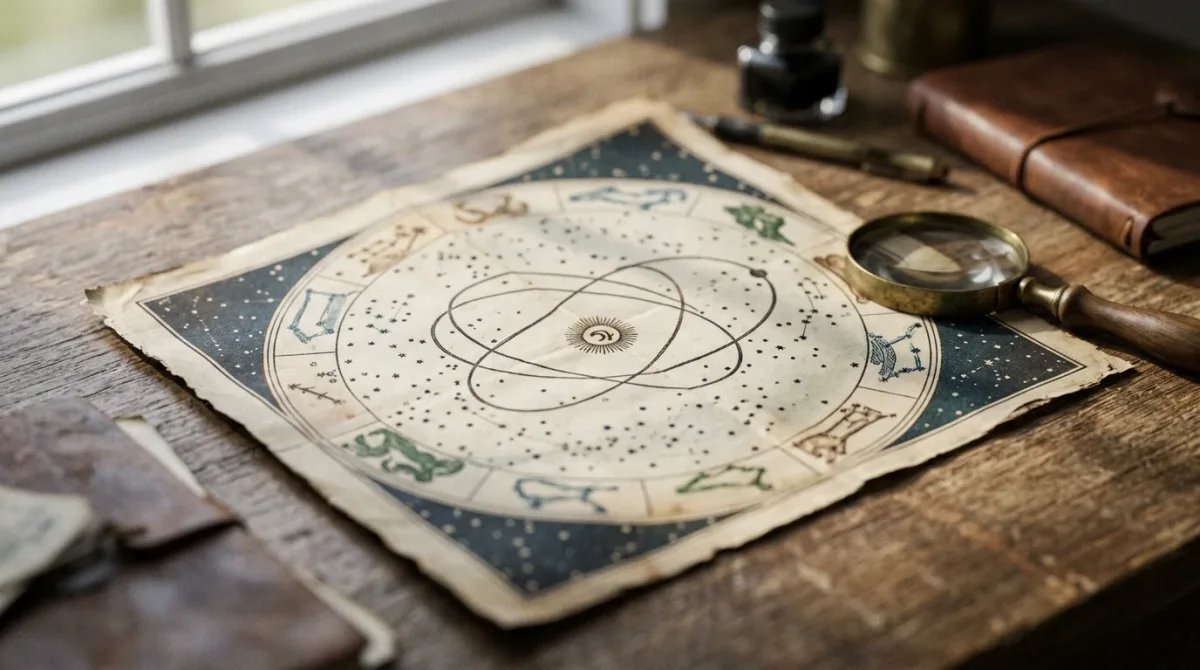
Mercury retrograde is not a change in the planet's path — it is an optical illusion, and the belief that it disrupts daily life dates to a much older astrological tradition than most people invoking it realize. NASA's Space Science Education resources describe the effect as the result of Earth passing a slower-orbiting Mercury, not any real reversal in the planet's motion, a distinction that predates the phrase's current status as a cultural punchline.
This is entertainment, not forecasting: the section below traces where the Mercury retrograde scare came from and why it stuck, as a matter of media and cultural history — not as a claim about what the planet does to anyone's week.
What does "Mercury retrograde" actually describe, astronomically?
It describes an apparent, not physical, reversal in Mercury's path across the night sky. According to NASA's StarChild educational resource, planets normally appear to move west to east against the background stars, a pattern astronomers call prograde motion. Retrograde motion happens "roughly when a faster moving planet catches up to and passes a slower moving planet," the agency explains — in Mercury's case, Earth overtaking Mercury in its orbit around the sun.
NASA's own analogy: if you walk faster than a friend beside you, the friend appears to drift backward as you pass, even though they never stopped moving forward. Mercury never stops orbiting the sun in one direction. The "backward" motion is a trick of relative position, visible from Earth several times a year, not a disruption in the solar system.
Where did the negative meaning come from?
The unlucky reputation is old, tracing to horary astrology — a branch that answers a specific question based on the chart cast at the moment it's asked. Nicholas Campion, a historian of cultural astrology at the University of Wales, has said that in that tradition, a retrograde Mercury at the time of a question was read to mean "nothing will come of it," according to reporting by Time. That is a narrow, technical reading built for one use case, not a general life warning.
The leap from a horary technicality to a catch-all excuse for delays, miscommunication, and technology mishaps happened gradually, and mostly in the 20th century, as astrology moved from specialist practice into mass media.
How did Mercury retrograde become a mainstream phrase?
It rode the same wave that made sun-sign astrology a newspaper fixture. Time's reporting traces personalized sun-sign horoscopes to 1930, when British astrologer R.H. Naylor published one of the first in the newspaper Sunday Express; American Astrology magazine later ran an early horoscope format explicitly tying birth dates to zodiac signs. Astrologer Linda Goodman's bestseller "Sun Signs" pushed zodiac identification further into the mainstream in the 1960s, per Time's account.
By the 1980s, call-in horoscope phone lines had broadened retrograde-season warnings to cover "everything," per Time's account, not just the narrow questions horary astrology originally addressed. The internet did the rest: Time reports that Google search interest in "is Mercury in retrograde" began climbing sharply starting around 2009, tracking the rise of social media, where the phrase became shorthand — and a running joke — for any bad-tech, bad-luck day.
Who still uses Mercury retrograde as a cultural reference, and how?
Contemporary astrology writers keep the phrase in circulation as a framing device for the everyday friction people already notice — delayed flights, dropped calls, an email that never arrives. Astrologer Tali Edut, one half of the astrology duo known as the AstroTwins, has traced astrology's broader lineage to "the time of the ancient Babylonians," later developed by the Greeks, according to NBC News reporting — a history far longer than the retrograde meme itself.
Scientists are direct about where the evidence stands. Michael Shara, curator and director of astrophysics at the American Museum of Natural History, told NBC News there is "absolutely no evidence, or reason to expect from science, that Mercury or any other planet has any effect whatsoever on life on Earth," adding that astrology "has no more scientific basis than alchemy or belief in the existence of unicorns." No peer-reviewed research supports a causal link between planetary position and daily mishaps.
Why does the phrase persist despite that?
Because it is useful shorthand, not because it is measurable. A shared cultural reference for "today is going sideways" travels faster than an explanation, and it costs nothing to say. Campion's read, via Time, is that technology and media habits — newspaper columns, phone lines, then search and social platforms — shaped how each generation encountered the idea more than any change in the underlying astrological technique did.
Read that way, Mercury retrograde's staying power says more about how folklore spreads through mass media than about the planet itself. It is a piece of pop-astrology history worth knowing as history — a label people reach for, not a mechanism anyone has shown to operate.
Does the same illusion happen with other planets?
Yes — retrograde motion is not unique to Mercury; NASA's StarChild resource describes it as a general effect of relative orbital speed that applies whenever a faster-moving planet passes a slower one as seen from Earth. Mars, Venus, Jupiter, and the outer planets all display apparent retrograde periods on their own schedules, visible from Earth at predictable intervals tied to each planet's orbit.
Mercury's version gets outsized attention mainly because it happens more often than retrogrades of the slower-orbiting outer planets, giving the shorthand more chances to recirculate online each year.
A quick note on how this section works
Content in this space is offered for entertainment and cultural context only. It does not predict outcomes, does not apply to any real person named here, and it is not a basis for career, financial, health, or other real-world decisions.
For a related careers perspective, read How to use pay-transparency laws to negotiate a higher salary.