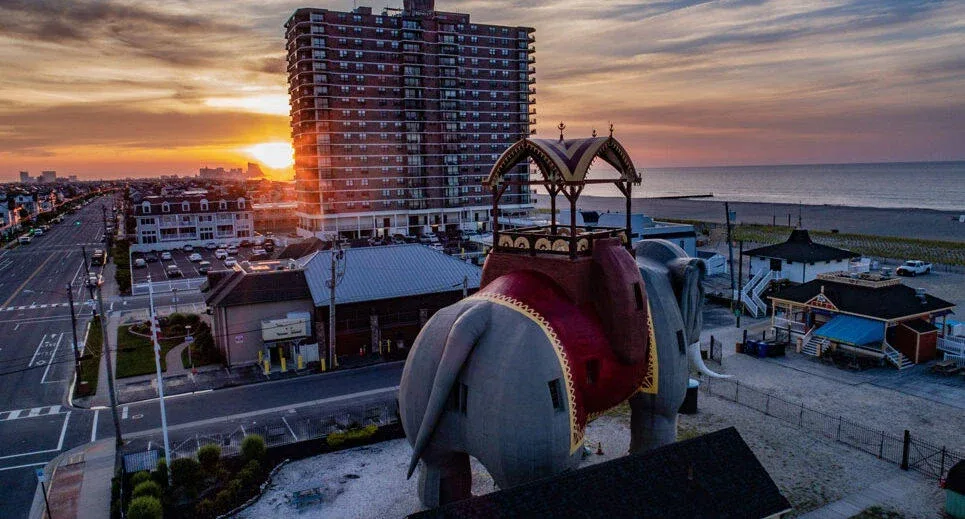
On Atlantic Avenue in Margate, a six-story wooden elephant named Lucy turned 145 this month, and the nonprofit that keeps her standing thanked the town's own public works and police departments for their help, according to the group's news page. The milestone traces back to a Margate resident, Edwin T. Carpenter, who organized neighbors in 1969 to stop the landmark from being torn down for beachfront redevelopment.
Lucy is one of the New Jersey institutions kept alive by ordinary people who decided a place was worth the fight, the kind of story VIP Jersey Express follows across the fourth-generation bakers and lifelong coaches profiled in towns up and down the state. In Margate, the fixture is a wooden elephant-shaped building at 1 Lucy Plaza, just off 9200 Atlantic Avenue, that has watched over the beach since the 1880s. She sits inside Josephine Harron Park, a fenced strip of beachfront the city of Margate itself acquired through a 1932 public referendum, according to the landmark's history page — a detail that matters later, since it is the same city-owned ground the elephant would eventually be moved onto.
The structure began as a real-estate promotion. The landmark's own about page says Philadelphia developer James Lafferty built the elephant-shaped structure in 1881 as the "Elephant Bazaar"; the landmark's history page instead dates construction to 1884, under the name "Light of Asia." Both accounts agree Lafferty built three elephant-shaped buildings and that Lucy is the only one still standing. The building was renamed Lucy in 1902 by Sophia Gertzen, who converted it into a tavern, according to the about page. After her husband John Gertzen died in 1916, Sophia kept the family's enterprise going by running a 40-tent tourist camp on the property, the history page states.
A Civic Association Forms to Save Her
By the late 1960s, Lucy had gone unused for years and was deteriorating. In 1969, Margate resident Edwin T. Carpenter organized neighbors into the Margate Civic Association specifically to address the building's condition, according to the landmark's history page. The group's plan was to move Lucy roughly two blocks down Atlantic Avenue to city-owned parkland and restore her there.
The move did not go as scheduled. July 20, 1970, was the original date set to relocate the building, but a legal injunction from the Atlantic Beach Corporation postponed it, the history page states. The building was ultimately donated to the newly formed Save Lucy Committee and moved to her current site in Josephine Harron Park along the beach. Contractors billed roughly $9,000 to prepare the house for moving and $15,000 to pour a new foundation at the relocated site, according to the same source, and a further $124,000 in restoration funding allowed tours to resume by 1974, with a ribbon-cutting attended by Margate's mayor and city officials.
The committee kept working the paperwork even after the ribbon-cutting. In 1975, it filed additional assistance applications with the federal Department of Housing and Urban Development, the National Park Service, and a New Jersey state office, the history page states, the kind of grant-chasing that keeps a wooden landmark standing long after the celebration ends. The federal government designated Lucy a National Historic Landmark the following year, in 1976. Mary Lafferty Garrison, a descendant of the elephant's original builder, is credited on the same page with supplying historical documentation and photographs that helped the committee make its case.
The Board President Who Watches the Forecast
Today the nonprofit Save Lucy Committee, Inc. still runs the landmark, with support that includes operating grants from the New Jersey Historical Commission, according to the organization's own site. Jason Tell now serves as the group's board president, a role that comes with unglamorous calls, like the one he made this summer to postpone an outdoor event ahead of severe weather.
"Our primary concern is always about the safety of our staff, volunteers, and guests," Tell said in a post on the landmark's news page announcing the postponement. "With the forecast calling for heavy downpours, severe thunderstorms, and damaging winds, plus an air quality warning, we had no choice but to postpone and reschedule."
It is the same basic calculation Carpenter's civic association made half a century earlier, on a larger scale: that an aging wooden landmark needed people willing to organize, raise money, and make unpopular calls to keep it standing for the next generation.
What the Anniversary Looks Like Now
This month's 145th-birthday celebration drew a crowd to the site, with organizers publicly thanking Margate city departments for their support, according to the news page. The nonprofit also marked the 56th anniversary of Lucy's 1970 move down Atlantic Avenue, and it has a second annual "Trunktoberfest" event planned for Saturday, October 17, an Oktoberfest-themed fundraiser at the site — the kind of recurring gathering that has replaced the emergency fundraising Carpenter's generation once had to run.
None of that changes the basic math of owning a six-story wooden building two blocks from the ocean. The Save Lucy Committee still leans on New Jersey Historical Commission operating grants to help cover upkeep, the same kind of state support the original preservation campaign sought out in the 1970s. Lucy is currently open to visitors from 10 a.m. to 8 p.m. inside a fenced park with picnic tables, according to the about page. The building stands six stories tall by the group's own account, still on Atlantic Avenue, still two blocks from where Carpenter's neighbors first pulled her out of the path of the wrecking ball, still run by volunteers and a board president who checks the weather forecast before every outdoor event.
For more context, read How the SBA Microloan Program Actually Works for Founders.
For more context, read Why Nonprofit Newsrooms Are Leaning Harder on Big Donors.
For more context, read How Charity Galas Actually Raise Money for Their Causes.